
Last updated September 16, 2026
Insulation Warning Signs: A Cypress Homeowner’s Reference Guide
A $40 jump in your July electric bill isn’t “just summer” - it’s your attic insulation telling you something changed. Every month you wait, that bill compounds, and the fix gets more expensive. Here’s the thing most Cypress homeowners miss: insulation doesn’t fail silently. It leaves fingerprints everywhere, in your utility data, in the way upstairs rooms feel at 5 p.m., in that faint musty smell near the garage ceiling. You just need to know how to read them. This guide - along with our Complete Guide to Insulation in Cypress - walks through every signal, what each one means, and which ones demand action this month.
Quick Answer
The most common signs of failing or inadequate insulation in Cypress homes are: rooms that stay hot in summer despite AC running, utility bills that climb year over year without a rate increase explaining it, and specific temperature differences between rooms that don’t match the thermostat setting. If your upstairs runs 8-10 degrees warmer than downstairs on a 90-degree day, or your AC cycles on and off more often than it used to, your insulation has likely degraded, settled, or was never sufficient in the first place.
Table of Contents
- The Bill Pattern Test: Reading 12 Months of SCE Data
- Room-Specific Temperature Clues: What Each Hot or Cold Zone Tells You
- Sensory Warning Signs: Smells, Sounds, and Drafts You Shouldn’t Ignore
- Visual Indicators: What to Look For Without an Inspector
- DIY Monitor vs. Professional Visit: The 30-Day Decision Framework
- Moisture and Mold: When Insulation Becomes a Health Issue
- Pests and Insulation: The Damage You Can’t Always See
- Common Mistakes to Avoid
The Bill Pattern Test: Reading 12 Months of SCE Data
Most Cypress homeowners look at their electric bill the wrong way. They see the total, sigh, and pay it. But that bill is a diagnostic tool, and 12 months of Southern California Edison data can tell you more about your insulation than a quick glance in the attic ever will.
Open your SCE account online. Pull 12 months of kilowatt-hour usage, not dollars. Dollars are affected by rate hikes; kWh is pure consumption. Now, separate your usage into three buckets: the hottest three months (typically July, August, September in Cypress), the coldest three months (December, January, February), and everything in between. This seasonal breakdown is covered in depth in our Seasonal Insulation Care for Cypress: Year-Round Homeowner’s Guide.
Here’s the bill-pattern test that separates insulation degradation from HVAC inefficiency from simple behavioral changes:
- Compare summer peak months year over year. If your August kWh usage this year is 18-25% higher than August two years ago, and you haven’t added a pool pump, an EV, or a second refrigerator, insulation loss is the most likely culprit. Attic insulation settles and compresses over time. Fiberglass batts that were R-30 in 2011 may be effectively R-19 today after years of compression, moisture exposure, and rodent traffic.
- Check your winter baseline. Cypress winters are mild, but a home with degraded attic insulation will show a winter heating bump that didn’t exist before. If December kWh is creeping up while your furnace is the same age and serviced regularly, heat is escaping through the attic faster than it used to.
- Rule out behavioral changes. If you added a home office, a new baby, or a generator backup system, that explains part of the increase. But behavioral load changes are usually flat month over month. Insulation failure shows up as a percentage increase that grows every month, not a one-time step up.
- Look for the signature of degradation. Insulation that has settled or been compromised by moisture shows up as higher cooling costs first, higher heating costs second. That’s because Cypress runs AC far more hours per year than heat. A 20% increase in July/August usage with a small winter increase is the classic degraded-attic-insulation signature.
One more data point worth pulling: SCE offers hourly usage data for most Cypress addresses. If you look at a hot August afternoon, you’ll see AC cycling. A well-insulated home in Cypress cycles the compressor for 15-20 minutes, then rests for 20-30 minutes. A poorly insulated home cycles for 30-40 minutes and rests for 10. If your compressor is running more than it rests during the 2-6 p.m. cooling window, the heat load is overwhelming your envelope, not your HVAC system.
If the bill-pattern test suggests insulation degradation, the next step is confirming it with a home energy audit. That audit doesn’t guess. It measures exactly where the heat is entering, and it gives you a prioritized fix list instead of a sales pitch.
Room-Specific Temperature Clues: What Each Hot or Cold Zone Tells You
The way different rooms in your Cypress home behave on a hot afternoon is a map of your insulation failures. In our experience, homeowners notice discomfort long before they notice a bill increase. The trick is matching the discomfort pattern to the likely root cause.
A consistently hot second floor. If your upstairs runs 8-12 degrees warmer than downstairs from 2 p.m. onward, even with all vents open and the AC set to 75, your attic insulation is the prime suspect. Heat doesn’t rise. Heat moves toward cold. In August, your attic sits at 130-150 degrees. That heat radiates downward through the ceiling all afternoon and evening. The only thing between your upstairs bedrooms and that superheated space is your attic insulation and air sealing. If the R-value is insufficient or has settled, the upstairs becomes an oven. This is the most common complaint we hear from Cypress homeowners in two-story homes built in the 1960s and 1970s, where original insulation was often R-11 or less.
A cold garage-adjacent room in January. Rooms above garages or sharing a wall with the garage often run 5-7 degrees colder in winter months. That points to missing or collapsed wall insulation in the shared wall, or insulation that was never installed in the garage ceiling cavity. Many Cypress homes built before 1980 have no insulation at all in garage-adjacent wall cavities. The fix is typically dense-packed cellulose or injection foam, not a full remodel.
A bedroom that won’t hold temperature overnight. If a room drops 4-5 degrees between 2 a.m. and 6 a.m. while the rest of the house holds steady, you likely have gaps around windows, recessed lights, or electrical outlets on exterior walls. These are air leaks, and they behave differently than insulation gaps. Air leaks cause fast temperature swings. Insulation gaps cause slow, steady heat gain or loss. Recognizing which one you’re dealing with tells you whether you need air sealing, insulation, or both. Most homes need both.
Rooms that vary 6+ degrees from each other at the same time. When a south-facing bedroom hits 82 while the north-facing bedroom sits at 76 with the same AC running, you’re seeing unequal insulation coverage. This happens when blown-in insulation was installed unevenly, or when attic insulation has been disturbed in one area but not others, often by a contractor running wiring, a rodent nesting zone, or a roof repair that compressed a section of batts.
The temperature test that matters most: on a day above 90 degrees, walk your home at 4 p.m. with a $15 infrared thermometer. Touch the ceiling in each upstairs room. Ceilings should feel cool to the touch. If a ceiling reads 85+ degrees while the room thermostat says 76, the attic insulation above that ceiling has failed or was never adequate. The same check works for walls in winter. Warm walls in January mean heat is leaking through.
Sensory Warning Signs: Smells, Sounds, and Drafts You Shouldn’t Ignore
Insulation problems don’t always show up in data or temperature readings. Sometimes they hit you in the nose, the ear, or the back of the neck. These sensory signals are often the earliest warning you’ll get, and most homeowners write them off as “old house quirks.” They’re not.
Musty Odors and Moisture-Compromised Insulation
A persistent musty smell near the attic hatch, in the garage ceiling, or wafting from wall cavities is a red flag. Fiberglass and cellulose insulation both lose R-value when wet. Fiberglass doesn’t absorb much water, but when it’s damp, the dead air spaces that give it insulating power collapse. Cellulose is worse. It’s made from recycled paper treated with borates. Once saturated, it compacts and can drop from R-3.7 per inch to less than R-1.5.
That musty smell means moisture is getting in. In Cypress, the usual suspects are bathroom exhaust fans venting into the attic instead of outside, roof leaks near flashing points, or condensation forming on the underside of the roof deck when warm attic air meets cold winter roof surfaces. Whatever the source, wet insulation is failing insulation, and the smell won’t go away until the insulation is removed and replaced. This is one of the services we handle directly: attic insulation replacement in Cypress starts with finding the moisture source, not just swapping the batts.
Drafts at Interior Walls and Unexpected Spots
You expect a draft near a window or an exterior door. You don’t expect one near an interior wall, a staircase, or an electrical outlet. If you feel air moving in the middle of your house on a calm day, you’re feeling the stack effect. Warm air rises and escapes through the attic, pulling replacement air in through every gap and crack in the lower floors. That incoming air travels through wall cavities, under baseboards, and around outlets before you feel it.
The stack effect is an air sealing problem, not an insulation problem, but the two go together. The gold standard in Cypress homes is attic air sealing combined with insulation. Air sealed first, then insulated. If you only insulate without air sealing, you’re putting a heavy sweater over a house with the windows cracked. Read more about how we approach the full treatment on our Warmline Insulation Co. home page.
Unusual HVAC Cycling Sounds
Listen to your AC on a hot afternoon. A system in a well-insulated home runs for 15-20 minutes, shuts off for 20-30, and repeats. A system in an under-insulated home runs for 45 minutes, shuts off for 5, and kicks back on. That short-cycling means your compressor is fighting a losing battle against heat gain, and it’s also shortening the life of the equipment.
If you hear the system cycling more frequently than it did two summers ago, and you haven’t changed your thermostat settings, your home’s thermal boundary is weakening. Insulation is failing. The HVAC equipment is doing its job. It’s working harder than it should have to.
The “Wall of Heat” Effect Near Ceilings
Stand on a chair in an upstairs hallway. Raise one hand near the ceiling. If the air 18 inches below the ceiling feels noticeably warmer than the air at chest height, your attic insulation isn’t stopping conductive heat transfer. That layer of trapped hot air is what happens when radiant heat from the attic penetrates the ceiling and heats the air below it. It’s a symptom of both inadequate insulation and missing radiant barrier in many Cypress attics.
Visual Indicators: What to Look For Without an Inspector
You don’t need a ladder into the attic to spot most insulation warning signs. Here are the visual checks that matter in Cypress homes, and what each one tells you.
Attic Hatch Condensation Rings
If your pull-down attic stairs or attic hatch shows a ring of discoloration, water staining, or even light surface mold, moisture is condensing at the thermal break. The attic hatch is the single least-insulated point in most homes. The thin plywood hatch has an R-value of about 1, while the surrounding attic has R-30 or more. Humid indoor air rises, meets the cold hatch surface, and condenses. That condensation ring is visible proof that warm, moist interior air is leaking into your attic. It also means your attic insulation is probably damp in the areas near the hatch, and damp insulation has lost much of its R-value.
Discolored Drywall Near Ceiling Edges
Walk the perimeter of each upstairs room and look where the ceiling meets the wall. Yellowish or grayish staining along the edges, especially in corners, indicates two possible problems: moisture penetration from the attic above, or surface condensation caused by thermal bridging. Thermal bridging happens where the ceiling drywall is screwed directly to the roof trusses or rafters. Those wood members conduct heat around the insulation, creating warm lines in summer and cold lines in winter. Those differential temperatures cause dust to adhere differently, creating visible “shadow lines” that look like cracks but aren’t. If you see a grid pattern of faint lines on your ceiling, that’s the framing showing through, which means insulation is missing or compressed around the edges where it matters most.
Visible Gaps Around Recessed Lights
Turn off the lights in an upstairs room and look up at any recessed (can) lights. If you can see a gap between the light trim and the ceiling, or if you see daylight coming through the gap in the attic during the day, you’re looking at an air leak that has been running 24/7/365 since the light was installed. Older recessed lights are not airtight. Each one is a chimney between your living space and the attic. In a Cypress home with 10 recessed lights, those 10 penetrations can equal the air leakage of leaving a window cracked open all summer.
The fix is installing airtight, insulation-contact rated (IC-rated) LED retrofit fixtures and sealing around each penetration. But sealing alone doesn’t restore lost insulation. The insulation above each old can light is usually missing or pushed back because old non-IC lights required a 3-inch clearance from insulation for fire safety. That’s 3 inches of unfettered heat transfer around every light.
Attic Dust Stains and Insulation Settlement
If you have a scuttle hole or hatch and can peek up with a flashlight, look for two things: black dust staining along the tops of the ceiling joists, and insulation that looks thinner near the eaves than in the center of the attic. The black stains are filtration dust. Air leaking from the house below carries dust that gets trapped in the insulation and along framing members. The darker the staining, the more air movement, the more heat loss in winter and heat gain in summer.
Insulation that’s 10 inches thick in the center but only 4 inches near the eaves is a sign of settlement or original under-installation. The edges of the attic are where thermal transfer is highest, because that’s where the roof deck is closest to the ceiling. Missing insulation at the perimeter is one of the most common findings in our Cypress home energy audits - and the first item on our Attic Insulation Maintenance Checklist for Cypress Homeowners - and it explains why edge rooms run hotter than central rooms.
DIY Monitor vs. Professional Visit: The 30-Day Decision Framework
Some insulation warning signs are watch-and-wait situations. Others need a professional within 30 days. Here’s how to tell the difference in Cypress, where the climate makes certain failures time-sensitive.
DIY monitor situations (track for 30-60 days, no immediate call needed):
- Temperature differences of 3-5 degrees between rooms on hot days, with no other symptoms. Track with a simple thermometer log. If the gap grows, call.
- A single month of elevated electricity usage. One hot August doesn’t prove anything. Two consecutive months of 15%+ increases over prior year does.
- A faint musty smell that appears only on very humid days and disappears when the AC runs. You may have a seal issue around a window or door. Track it.
Professional-within-30-days situations (don’t wait):
- Visible mold growth on any ceiling, wall, or attic surface. Mold spreads. In Cypress’s climate, a small patch in October becomes a big patch by December. This is a moisture and insulation failure together, and it needs removal, not just cleaning.
- Signs of rodent activity: droppings in the attic, scratching sounds at night, chewed wiring, or nests visible around insulation. Rodents destroy insulation by burrowing and compressing it. They also chew wiring, which is a fire hazard. The attic cleaning and rodent proofing work handles both the pest issue and restores the insulation.
- Duct failure symptoms: a room that suddenly stopped getting airflow, or visible duct tape hanging loose in the attic. When ducts pull apart, conditioned air dumps into the attic. Your AC runs constantly, the attic gets artificially cool, and your insulation becomes irrelevant because the air never reaches your living space.
- Water staining that appears after rain. A roof leak that has reached the insulation is an emergency. Wet insulation loses R-value immediately and doesn’t recover when it dries. The affected insulation should be removed and replaced.
- Temperature differences of 10+ degrees between the upstairs and downstairs on a normal Cypress afternoon. That’s not a minor comfort issue. That’s a thermal envelope failure that’s driving your AC to work dangerously hard.
The 30-day line is important because of how Cypress weather interacts with insulation failures. Our mild climate means moisture that gets into insulation often stays there for weeks, because temperatures don’t get extreme enough to dry it out. That trapped moisture breeds mold, attracts pests, and slowly compresses the insulation. A problem ignored in October is still there in March, and it’s worse.
Moisture and Mold: When Insulation Becomes a Health Issue
Cypress sits close enough to the coast that our homes deal with humidity patterns many inland cities don’t experience. Morning marine layer, followed by hot dry afternoons, followed by cool evenings with dew point swings. Those temperature and humidity swings put stress on any home’s thermal envelope, and when insulation is compromised, that stress becomes visible.
Mold in insulation is more common than most homeowners realize. The signs are usually olfactory before they’re visual: a persistent earthy or musty smell, stronger in the morning, that seems to come from nowhere specific. That smell means mold spores are present. The mold itself may be out of sight, growing on the paper backing of fiberglass batts or in cellulose that’s absorbed attic condensation.
Here’s what matters: moldy insulation does not get “cleaned.” It gets removed. You can’t kill mold in fiberglass batts and expect the insulation to work properly afterward. The R-value has already been compromised by the moisture that allowed the mold to grow. The right fix is removal and replacement, followed by fixing the moisture source so the new insulation doesn’t suffer the same fate.
Common moisture sources we find in Cypress attics:
- Bathroom exhaust fans venting directly into the attic instead of through the roof. This is code-noncompliant and pumps a pint of moisture into the attic with every shower.
- Kitchen range hoods venting into the attic. Same issue, with the added grease problem.
- Roof leaks at flashing points around vents, skylights, and chimneys. These are slow leaks that don’t show inside the house until months after they start.
- Condensation on the underside of the roof deck during winter, when warm interior air leaks into a cold attic and the moisture in that air condenses on the roof sheathing.
If you smell musty air and your attic hatch shows a condensation ring, the smart move is a professional assessment and likely spray foam or blown-in replacement. Spray foam, properly applied, acts as both insulation and air barrier, which addresses the moisture source and the insulation failure in one pass. It’s the material choice we recommend most often for Cypress attics with chronic condensation issues, and the Icynene and Demilec open-cell foams handle our climate’s moisture dynamics well.
Pests and Insulation: The Damage You Can’t Always See
Rodents and insulation don’t mix. Rats and mice in Cypress attics are common year-round, and the damage they do to insulation is cumulative and expensive. The signs are obvious once you know what to look for, but most homeowners miss them until the damage is substantial.
What rodent activity does to insulation:
- Burrowing and tunneling compresses fiberglass and cellulose, cutting R-value by 30-50% in affected areas. A rat highway through your attic insulation is a thermal superhighway.
- Urine and droppings soak into insulation and create permanent odor and bacteria problems. Insulation soaked with rodent waste must be removed. It can’t be sanitized in place.
- Chewing damages both insulation facing and, critically, electrical wiring. Rodents chewing on wiring is the cause of an estimated 20-25% of all house fires with unknown origin sources.
- Nesting materials (shredded insulation, roof decking, cardboard) pack into soffit vents and block ventilation. A blocked soffit vent means the attic can’t breathe, which raises attic temperatures 20-30 degrees and accelerates heat transfer into the house.
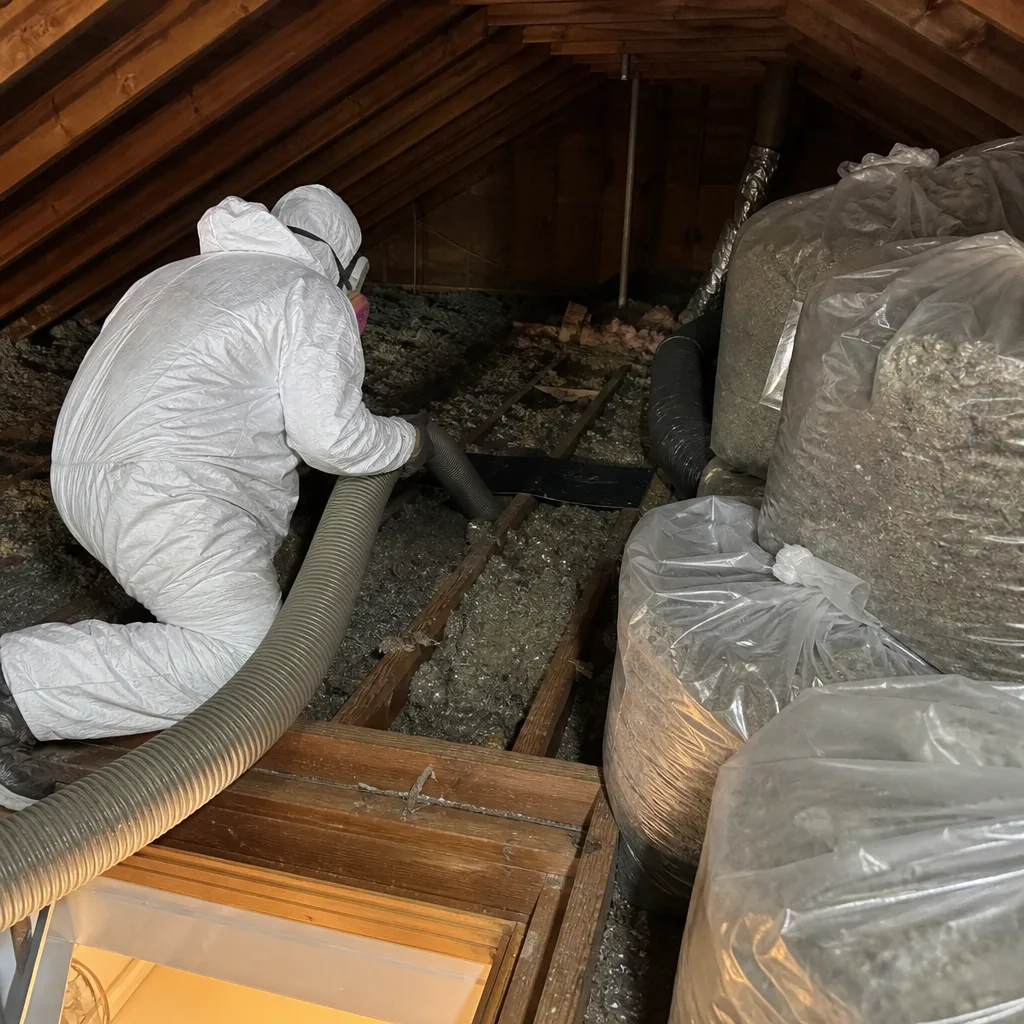
The sequence matters: rodent proofing first, then insulation replacement. If you re-insulate before proofing, you’ve just given the rats fresh bedding. The attic cleaning and rodent proofing service removes the contaminated insulation, cleans the space, seals the entry points, and then installs new insulation. In Cypress, the most common entry points are roof-to-wall intersections with gaps, unscreened gable vents, and pipe penetrations that weren’t sealed at construction.
If you hear scratching in the ceiling at night, especially between 10 p.m. and 2 a.m., you almost certainly have rats in the attic. Roof rats are the dominant species in Cypress. They’re arboreal, meaning they live in trees and enter attics from overhanging branches, power lines, and roof edges. They’re also neophobic, meaning they avoid new objects. Traps alone often don’t solve the problem. Exclusion, the process of sealing every entry point, is the only permanent fix.
Common Mistakes to Avoid
- Adding insulation without air sealing first. If your attic has air leaks, new insulation just filters more air through it. Filtration dust blackens the new batts within a year. Air seal first, then insulate. We see this mistake in Cypress homes that got “insulation upgrade” cheap jobs from fly-by-night crews. The homeowner paid twice: once for the ineffective job, once for us to fix it.
- Assuming one hot room means the AC needs service. Your HVAC is often the innocent bystander. Before you spend $300 on an AC service call, check whether the hot room is an edge room, above a garage, or under an attic section that’s missing insulation. The problem may be thermal, not mechanical.
- Ignoring the musty smell because it’s “faint.” Faint becomes strong. Mold that’s growing in compressed insulation doesn’t self-resolve. By the time the smell is strong, the affected insulation is a complete loss and the drywall may be compromised too.
- Using fiberglass batts in a vented attic and calling it done. Batts are only as good as the installation. Gaps, compression, and misfit cuts reduce effective R-value by up to 30%. In a Cypress attic, the difference between a perfectly installed batt job and a typical rushed one is thousands of dollars in energy costs over 10 years. Blown-in insulation eliminates most installation error because it fills irregular cavities naturally.
- Blocking attic ventilation with added insulation. If you add insulation and it blocks the soffit vents, you’ve created a superheated attic with no airflow. Attic temperatures climb, heat transfer increases, and your cooling costs may go up, not down, despite the added R-value. Proper attic work includes baffles to keep ventilation channels open.
- Waiting for the “right time” to fix insulation. There’s no good season to waste energy. Cypress summers are long and hot. Every month with degraded insulation costs you money and wears down your AC. The $89 seasonal tune-up covers HVAC maintenance, but it doesn’t fix the thermal envelope. The insulation work needs its own timeline.
- Choosing the cheapest quote without checking what’s included. Insulation pricing varies by material type, R-value, prep work, and air sealing scope. A quote that’s half the market rate is usually omitting air sealing, using lower-grade materials, or both. Get the scope in writing. If it doesn’t mention air sealing, ask why.
When to Call a Professional
Some insulation work is genuinely DIY-accessible: replacing weatherstripping, adding a pre-cut attic hatch cover, swapping incandescent bulbs for LEDs to reduce attic heat from can lights. But the warning signs covered in this guide mostly point to systemic issues: moisture intrusion, rodent damage, settling, air leakage, and inadequate original coverage. These are not weekend projects.
If you’ve run the bill-pattern test and seen consecutive month-over-month increases, if your upstairs runs 8+ degrees hotter than downstairs, if you smell musty air or hear night scratching, get a professional assessment. Warmline Insulation Co. offers free estimates in Cypress - call (657) 837-1179 and a live person answers, 24/7. We’ve been serving Cypress since 2011, and our team handles everything from the diagnostic home energy audit to the final blown-in insulation installation, all under one roof and backed by our 90-Day Done Right Promise.
Frequently Asked Questions
Hot bedrooms on summer afternoons, especially upstairs, utility bills that climb year over year without explanation, and rooms that vary more than 5-6 degrees from each other are the three most common signals. Secondary signs include musty odors near the attic, condensation rings around the attic hatch, and AC systems that cycle on and off more frequently than they used to. If you’re seeing any of these, a home energy audit will pinpoint the failing zone before you spend money on guesses.
Look for three clues: an attic where insulation is noticeably thinner near the eaves than in the center, black dust staining along ceiling joists visible from the attic hatch, and a consistent year-over-year increase in your summer cooling kWh without behavioral changes. Attic insulation in Cypress homes from the 1960s through the 1990s is often original and well past its effective life. We see R-11 batts labeled as “adequate” in homes that now need R-38 for our climate zone.
A 2-3 degree difference is normal. An 8-10 degree difference is not. That gap means heat is entering the upstairs faster than the AC can remove it, which points to attic insulation failure, missing air sealing around ceiling penetrations, or both. In our Cypress energy audits, we routinely find upstairs bedrooms running at 82 degrees while the thermostat reads 75, and the cause is almost always thermal, not mechanical.
No. Insulation that has been wet or has visible mold growth has lost R-value and cannot be restored. The affected material needs to be removed, the moisture source fixed, and new insulation installed. This is exactly the kind of removal and replacement work we do regularly in Cypress, where coastal humidity patterns make attic condensation a recurring issue in under-ventilated homes.
Most attic insulation replacement jobs in Cypress run between $1,500 and $4,000 depending on attic size, existing insulation condition, chosen material, and whether air sealing and rodent proofing are included. A full spray foam application is higher. The best way to get an accurate number is a free estimate with a written scope. Call (657) 837-1179 and we’ll walk your attic and give you a firm price before any work begins. We also offer $50 off any repair over $250 and a permanent 5% discount for seniors and veterans.
Most blown-in attic insulation jobs in Cypress are completed in a single visit. Preparation (air sealing, baffles, any needed removal) may add time depending on the attic condition, but the majority of our insulation work is one-day. The upfront pricing quote covers everything, so there are no surprises at the end of the job. A live person answers the phone 24/7 if you need to schedule or ask questions.
The Bottom Line
Failing insulation announces itself. You just have to know what you’re listening for: a $40 monthly bill increase that doesn’t go away, an upstairs that feels like a different climate zone, a musty smell that hangs around the attic hatch, a ceiling that’s warm to the touch on a hot afternoon. None of these signals resolve on their own. Insulation doesn’t heal. It degrades, settles, gets wet, gets chewed on, and loses R-value every year it’s not addressed. The good news is that the fix is well understood, and in Cypress, it’s a one-call job for a specialist who has been doing this since 2011.
Written by Neil Ashford, Owner at Warmline Insulation Co., serving Cypress since 2011.