
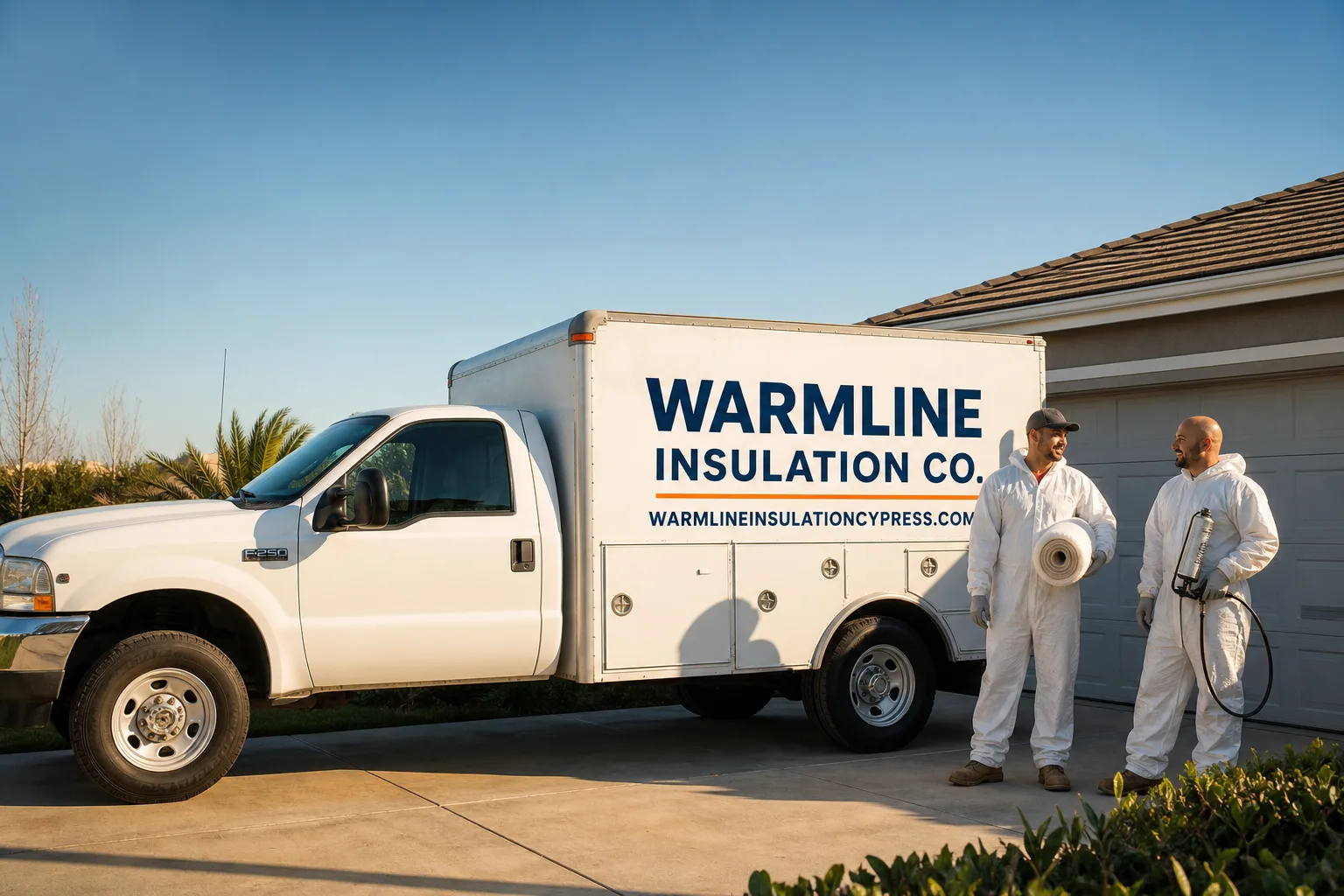
How Much Does Spray Foam Insulation Cost in Cypress?
Spray foam insulation in Cypress, CA typically costs between $1.50 and $4.50 per square foot, depending on foam type, application area, and the thickness required to hit California’s Title 24 energy code targets. Most Cypress homeowners spend between $2,800 and $7,500 for a complete attic or crawl space project, with smaller air-sealing jobs coming in around $600 to $1,200. Because open-cell and closed-cell foam perform very differently in Southern California’s climate, the type you choose matters as much as the square footage.
Spray Foam Insulation Cost Breakdown (2026)
Here’s how pricing breaks down for our Spray Foam Insulation services in Cypress and the surrounding cities. These are real ranges from real jobs – not national averages copied from a trade publication.
| Project / Application | Foam Type | Typical Cypress Price Range |
|---|---|---|
| Attic roof deck (unvented assembly) | Closed-cell (2″ to 3″) | $3,200 – $6,800 |
| Attic floor joists + air sealing | Open-cell (3.5″ to 5.5″) | $1,800 – $4,200 |
| Crawl space walls + rim joists | Closed-cell (2″) | $1,400 – $3,600 |
| Garage walls + ceiling | Open-cell or closed-cell | $900 – $2,800 |
| Wall cavity injection (existing walls) | Closed-cell | $2,200 – $5,500 |
| Rim joist sealing only | Closed-cell (2″) | $600 – $1,400 |
| New construction framing (whole house) | Open-cell or hybrid | $5,500 – $14,000+ |
| Small targeted air sealing gaps | Two-part DIY-kit-grade or contractor foam | $350 – $900 |
Open-cell foam runs roughly $0.44 to $0.65 per board foot installed in the Cypress market. Closed-cell, which delivers a higher R-value per inch and acts as a vapor retarder, typically runs $1.00 to $1.50 per board foot. The gap between those numbers reflects the cost of the chemicals themselves – closed-cell uses more expensive blowing agents – plus the slower application speed. A 1,500-square-foot attic in Cypress might take our crew four to six hours for open-cell but a full day or more for a closed-cell roof deck conversion. Labor runs about 30-40% of most spray foam invoices in this market.
If you’ve been quoted a figure well below these ranges, ask whether the installer is meeting California’s current Title 24 compliance thresholds. Undershooting the required R-value to cut cost is common with low-bid contractors, and it means your home fails inspection and loses efficiency from day one.
What Affects Spray Foam Insulation Pricing in Cypress
No two Cypress homes price out the same. Here are the six factors that move the number up or down most significantly on the jobs we see in this area.
- Foam type – open-cell vs. closed-cell: Closed-cell foam costs roughly twice as much per board foot as open-cell, but in a humid coastal microclimate like Cypress – where marine layer moisture rolls in from Huntington Beach and Seal Beach overnight – closed-cell’s vapor resistance often makes it the smarter long-term choice for crawl spaces and exterior wall assemblies. Open-cell is excellent for interior attic floors and sound control, where vapor control isn’t the primary driver.
- Existing insulation removal: Many Cypress homes built in the 1960s and 70s – particularly the tracts along Katella Avenue and Orange Street – still have their original fiberglass batts, and some have had multiple layers added over the decades. Removing that material before spray foam goes in adds $400 to $1,200 depending on depth and contamination. We handle removal and replacement in-house, so you’re not coordinating two separate contractors.
- Attic access and clearance: A standard pull-down attic stair and a clean 24″ clearance is a straightforward setup. Cypress has a surprising number of older ranch-style homes with flat or near-flat roofs and extremely tight attic cavities. Tight access means slower equipment staging, more protective sheeting, and sometimes smaller spray hoses – all of which increase labor time and cost.
- California Title 24 compliance requirements: California’s energy code sets minimum R-values that vary by climate zone. Cypress falls in Climate Zone 8, which requires R-19 minimum for attic floors and R-13 for walls in most residential applications. To hit R-19 with closed-cell foam, you need about 3 inches of thickness. Some contractors quote thinner applications and leave homeowners short of compliance – we build Title 24 targets into every scope of work from the start.
- Surface preparation and moisture conditions: If a crawl space shows signs of moisture intrusion – which we see frequently in Cypress homes near the flood plain areas around Moody Street and Denni Street – the substrate needs to be dry and sometimes treated before foam adheres properly. Moisture-related prep can add $200 to $600 to a crawl space project.
- Project size and total square footage: Spray foam has high equipment mobilization costs. A crew needs to heat and pressurize the chemical drums, lay protective sheeting throughout the home, and flush the spray lines – all before the first bead of foam goes on. That’s why small jobs cost more per square foot than large ones. A 300-square-foot rim joist seal might cost $2.50 per square foot while a 2,000-square-foot attic floor job might land at $1.75 per square foot – the math is the same; the fixed startup cost is spread over more area on larger projects.
Open-Cell vs. Closed-Cell Foam: Which Makes More Sense in Cypress?
This is the question we get most often on estimates, and it’s worth a direct answer rather than a vague “it depends.”
Cypress sits in a mild coastal-influenced climate where summer temperatures regularly hit the low-to-mid 90s and winter lows rarely drop below 45°F. The marine layer keeps relative humidity elevated, especially in the early morning hours. That climate context shapes the foam choice more than anything else.
Closed-cell foam (products like Icynene ProSeal or Demilec Heatlok HFO) delivers R-6 to R-7 per inch, adds structural rigidity to wall cavities and roof decks, and acts as a Class II vapor retarder. In a Cypress crawl space or on an exterior-facing wall, closed-cell’s moisture resistance is a genuine advantage. It also handles the mild seismic loads this part of Orange County sees without cracking or delaminating the way rigid foam board sometimes does after years of minor ground movement.
Open-cell foam (products like Icynene Classic or Johns Manville’s open-cell line) delivers R-3.5 to R-3.7 per inch, costs significantly less per board foot, and is excellent for interior attic floor applications, interior wall sound control, and any area where vapor permeability is a plus rather than a liability. For a Cypress homeowner who simply wants to upgrade their attic floor from old R-11 batts to a proper R-30 or R-38, open-cell is usually the most cost-effective path.
A hybrid approach – closed-cell at the rim joist and crawl space walls, open-cell at the attic floor – is something we design fairly often for older Cypress homes where multiple assemblies need upgrading at once. It keeps cost down while putting the vapor-resistant material exactly where moisture is the actual threat.
Spray Foam vs. Other Insulation Types: Cost Comparison for Cypress Homeowners
Spray foam isn’t always the right answer for every application, and we’ll tell you that plainly on any estimate. Here’s how it compares to the other insulation types we install.
- Blown-in fiberglass or cellulose: $0.60 to $1.20 per square foot installed in an attic. Much lower upfront cost, good R-value per dollar, but provides no air sealing. In a leaky 1970s Cypress home, blown-in without air sealing can underperform spray foam by 30-40% in real energy savings.
- Fiberglass batts: $0.50 to $1.10 per square foot. Lowest upfront cost, but batts in wall cavities are notoriously difficult to install without gaps – and gaps mean thermal bridging. Fine for new construction with careful installation. Poor retrofit performance in older Cypress homes.
- Rigid foam board: $0.70 to $1.40 per square foot for material; add labor. Good for specific applications (exterior continuous insulation, under-slab). Not practical for irregular cavities or retrofit attic conversions.
- Spray foam (open-cell): $1.50 to $2.75 per square foot installed. Seals and insulates in one pass. Best value in irregular attic spaces and rim joists.
- Spray foam (closed-cell): $2.75 to $4.50 per square foot installed. Premium price, premium performance. Best for vapor control zones, unvented roof assemblies, and crawl spaces.
The real cost comparison isn’t just installation price – it’s installation price plus energy savings over time. A properly air-sealed and spray-foamed attic in Cypress can reduce HVAC runtime by 20-35%, which on a typical SCE bill in this area translates to $40 to $90 per month. Over five years, that payback matters more than the day-one invoice.
How Spray Foam Insulation Saves Cypress Homeowners Money Long-Term
We’ve been doing this work in and around Cypress since 2011, and the payback stories we hear from homeowners two or three years after a spray foam project are consistent: the house feels different from the first week, and the utility bill reflects it within a month or two.
Here’s why the math works in a Southern California coastal climate. Cypress homes spend most of their cooling load fighting infiltration – hot, dry air pushing in through attic bypasses, rim joists, and recessed light fixtures during summer afternoons, and marine layer humidity working through crawl space vents at night. A good batt job reduces conductive heat loss but does almost nothing about that air exchange. Spray foam eliminates both conduction and infiltration in a single application.
In the Cypress neighborhoods around Denni Park and the streets off Valley View, we regularly find homes where the air leakage rate (measured in ACH50 during a blower door test) drops by 40-60% after a spray foam project. That reduction shows up directly on the SCE or SoCalGas bill.
California also offers utility incentives through programs like TECH Clean California that can offset spray foam costs when paired with HVAC upgrades. A home energy audit – which we offer as a standalone service – is the best way to identify which combination of upgrades gives you the fastest payback specific to your Cypress home’s construction year, insulation history, and current air sealing condition.
How to Save on Spray Foam Insulation in Cypress
There are real ways to reduce what you pay for a spray foam project without cutting corners on performance. Here’s what we tell homeowners before they sign anything.
- Start with a home energy audit. A diagnostic audit identifies exactly which assemblies are leaking the most energy. You might find that your crawl space is the priority and your attic can wait a year – or vice versa. Treating the highest-loss area first gives you the fastest return on whatever you spend.
- Bundle projects. Because spray foam has high equipment mobilization costs, combining an attic project with rim joist sealing or crawl space work on the same day spreads that fixed cost and lowers your per-square-foot price meaningfully. On a combined attic-plus-crawl-space job, the total is usually 10-15% less than scheduling them separately.
- Check for utility rebates before signing. Southern California Edison’s residential programs and the state’s TECH Clean California initiative periodically offer rebates on air sealing and insulation tied to verified performance improvements. Eligibility changes, but it’s worth confirming before your project date. We’ll tell you what we know about current availability when you call.
- Ask about our standing discounts. Warmline Insulation Co. offers $50 off any repair over $250, and a permanent 5% Senior and Veteran discount on all services. If your project qualifies, we apply it automatically – you don’t need to ask twice.
- Don’t pay for foam you don’t need. Some contractors upsell closed-cell everywhere regardless of application logic. Open-cell is genuinely appropriate for many Cypress attic floor projects and costs substantially less. An honest scope of work matches the foam type to the assembly, not to the maximum ticket price.
- Get your estimate while the season is right. Spring is consistently our busiest scheduling window in Cypress as homeowners prep for summer heat before June. If your project isn’t urgent, late fall and winter scheduling often means faster turnaround and occasionally better pricing flexibility.
The fastest way to get a real number for your specific home is to call us directly at (657) 837-1179. A live person answers every call – no voicemail, no callback queue. We’ll ask a few questions about your home’s age, square footage, and what’s already in place, and we can often give you a ballpark before we even visit. Free estimates, upfront pricing, no pressure.
What the Installation Process Looks Like
One of the most common questions Cypress homeowners have before agreeing to a spray foam project is: what is this actually going to look like in my house? Here’s a plain-spoken walkthrough.
Before any foam goes on, our technicians lay protective sheeting over surfaces, furniture, and HVAC equipment that could be affected by overspray. Spray polyurethane foam is a two-component system – an “A-side” isocyanate and a “B-side” polyol blend – that mix at the spray tip and expand immediately on contact with the surface. The chemical reaction generates heat, so the drums need to be at a specific temperature range before spraying begins. This is why professional equipment matters: improperly heated or pressurized components produce foam with compromised cell structure and R-value. Products like Demilec Heatlok HFO and Icynene ProSeal are formulated to specific application parameters that our technicians follow on every job.
Once sprayed, open-cell foam reaches tack-free in roughly 60 seconds and full cure in a few hours. Closed-cell is faster to full cure. Most Cypress projects are completed in a single visit, which means you’re not scheduling around multiple crew days or living in a disrupted home for a week.
A safety note: spray foam installation involves chemicals that require proper respiratory protection and ventilation during application. Occupants and pets should not be in the home during spraying or for the period specified on the product’s safety data sheet – typically two to four hours after application ends. Our technicians will give you a clear re-entry window before they start. This isn’t something to shortcut.
After the foam is cured, we do a walk-through with you – we show you what was done, where, and why – before anyone signs off. The 90-Day Done Right Promise is in writing: if anything about the installation doesn’t perform as scoped, we come back and make it right. No arguments, no runaround.
Why Cypress Homes Have Specific Insulation Challenges
Cypress is worth understanding as a distinct market, not just “Southern California generic.” The city’s housing stock skews heavily toward the 1950s-through-1970s construction era, when California’s energy code was essentially nonexistent. Homes in the tracts around Orange Street, Moody Street, and the older sections near the Cypress community center were built for mild weather – single-pane windows, minimal wall insulation, and vented crawl spaces that made sense before we understood moisture dynamics the way we do now.
The result is that a large share of Cypress homes we visit have either no wall insulation, degraded original fiberglass batts with significant settling and compression, or crawl spaces where the original vapor barrier has failed and moisture has been working on floor joists for decades. Spray foam is often the most efficient single solution for these conditions because it addresses both thermal performance and air sealing in one application – something a blown-in cellulose job, however well done, can’t fully replicate in an older assembly with complex bypass paths.
Cypress also sits close to the water influence zone that extends inland from the Pacific Coast. Marine layer humidity is a real factor in crawl space moisture management here, and it’s one reason we favor closed-cell foam in crawl space applications in this city specifically – where a contractor 20 miles inland might reasonably lean on open-cell more often.
If you’re looking at the full picture of what Spray Foam Insulation in Cypress can do for your home – not just pricing but application options, scope design, and how it connects to the rest of your home’s performance – that’s the place to start. And if you’re exploring other services beyond spray foam, our home page gives you the full picture of what Warmline handles under one roof.
FAQs – Spray Foam Insulation Cost in Cypress
How much does spray foam insulation cost per square foot in Cypress, CA?
Spray foam insulation in Cypress costs $1.50 to $2.75 per square foot for open-cell and $2.75 to $4.50 per square foot for closed-cell, fully installed. These are contractor-installed figures that include materials, labor, protective sheeting, and cleanup – not just material cost. Smaller jobs run toward the higher end of those ranges because equipment setup costs are spread over less square footage. Call (657) 837-1179 for a free estimate specific to your home’s square footage and application.
How much does it cost to spray foam a 1,500 sq ft attic in Cypress?
A 1,500-square-foot attic in Cypress runs $2,700 to $4,800 for open-cell foam on the attic floor, or $4,800 to $8,500 for a closed-cell unvented roof deck conversion. The wide range reflects whether existing insulation needs to be removed first, the attic’s access conditions, and the target R-value. Homes in older Cypress neighborhoods often require removal of degraded original batts before new foam goes on, which adds to the total but is worth doing – spraying over compromised material defeats the purpose. Call (657) 837-1179 for an exact quote; estimates are free.
Is spray foam insulation worth the cost in Southern California’s climate?
For most Cypress homes, yes – particularly for crawl spaces, rim joists, and unvented attic assemblies where air sealing is as valuable as R-value. Cypress homeowners we’ve worked with since 2011 consistently report 20-35% reductions in HVAC runtime after a complete spray foam project. In a typical SCE billing cycle, that translates to $40 to $90 per month in savings. The payback period on a mid-range project is generally three to six years, after which the savings are pure return. Whether it beats blown-in for your specific situation depends on the application – we’ll give you a straight answer on that when we see the house.
Can spray foam insulation be installed in one day in Cypress?
Most spray foam projects in Cypress are completed in a single visit. A standard attic floor project on a 1,200 to 1,800 square foot home takes four to eight hours from setup to cleanup, including protective sheeting and the post-cure walkthrough. Larger whole-house projects or jobs with significant removal work may run into a second day, but that’s the exception. We’ll tell you the realistic time frame before we start – no surprises. Homeowners and pets need to stay out of the treated area for two to four hours after spraying ends; we give you a specific re-entry window before we begin.
Does Warmline Insulation Co. offer any discounts on spray foam insulation in Cypress?
Yes. We have three standing offers that apply to spray foam projects. $50 off any repair over $250 applies when you’re patching or supplementing existing foam or insulation. The 5% Senior and Veteran discount is permanent and applies to all services – we apply it automatically when it applies to you. And the $89 Seasonal Tune-Up is a good starting point if you want a professional look at your home’s current insulation condition before committing to a full spray foam project. These are our only standing offers; pricing is always upfront with no add-ons at the door.
Do I need a permit for spray foam insulation in Cypress, CA?
In most cases, spray foam insulation added to an existing home in Cypress does not require a separate building permit, but there are exceptions. Converting a vented attic to an unvented spray foam assembly (a hot roof) typically does require a permit in Orange County, because it changes the building’s energy compliance classification and affects fire code compliance. New construction always requires inspection. We handle permit coordination when it’s required – you don’t need to navigate the Cypress Building and Safety division on your own. We’ll tell you upfront whether your specific project needs a permit before any work begins.
Key Takeaways
- Spray foam insulation in Cypress costs $1.50 to $4.50 per square foot installed, depending on foam type and application.
- Most Cypress attic or crawl space projects land between $2,800 and $7,500 total.
- Closed-cell foam costs more per board foot but is the right choice for crawl spaces and exterior assemblies in Cypress’s marine-influenced climate.
- California’s Title 24 (Climate Zone 8) sets minimum R-values – make sure any quote you receive meets code.
- Bundling projects (attic + rim joist, crawl space + attic) lowers per-square-foot cost significantly.
- Warmline Insulation Co. has served Cypress homeowners since 2011, with upfront pricing, background-checked technicians, and a written 90-Day Done Right Promise on every job.
- A free home energy audit is the smartest first step if you’re not sure which insulation upgrade to prioritize.
Get a Free Spray Foam Estimate in Cypress
Neil Ashford and the Warmline Insulation Co. team have been insulating Cypress homes since 2011. If you’re tired of high utility bills, rooms that never quite cool down in August, or a crawl space that makes you nervous every time you think about it – let’s look at what’s actually going on. We’ll give you a free, no-obligation estimate with upfront pricing and a clear scope of work before any foam goes on your walls or attic.
Call (657) 837-1179 – a live person answers every call, 24/7. Most Cypress projects are completed in a single visit, and every job is backed by our written 90-Day Done Right Promise. If it’s not right, we make it right. That’s not a slogan; it’s in writing.
Senior or Veteran? Your 5% discount is already applied. Ask us about current utility rebate programs in Cypress when you call – availability changes, and we’ll tell you exactly what’s on the table for your project.
Pricing reflects the Cypress market as of 2026. Warmline Insulation Co. offers free estimates – call (657) 837-1179.
Written by Neil Ashford, Owner at Warmline Insulation Co., serving Cypress, CA since 2011.
What Our Customers Say
"Injection foam in the walls of our 1950s house - no drywall demolition, just small holes patched and painted the same day. The street noise in the front bedroom is half what it was."
- Yasmin Farah"Upstairs was ten degrees hotter than downstairs every summer. They pulled the attic to bare joists, air-sealed every can light and top plate first, then blew it to R-49. First August in this house where the bedrooms and the living room read the same on the thermostat."
- Marcus Hale"The estimate had every line itemized - removal, sealing, baffles, the blown-in by the bag - and the final invoice matched it exactly. Two other companies quoted a single number and could not tell me what R-value they were installing."
- Priya Raman