
Last updated September 16, 2026
The Complete Guide to Insulation in Cypress
Most Cypress homeowners find out their insulation is failing in August, when the AC runs six hours straight and the bill hits $300. The system isn’t broken. The envelope was never right to begin with. Cypress sits in a strange climate pocket: close enough to the coast to pull marine air inland, far enough inland to bake in summer heat. That combination quietly degrades insulation from the inside out, and most generic California guides never mention it. This guide maps every insulation decision to Cypress-specific conditions, home eras, and utility realities, and you can explore more guides & resources to fix the right problem the first time.
Quick Answer
The complete insulation strategy for a Cypress home starts in the attic, because that’s where 25 to 40 percent of conditioned air escapes. Most homes built before 2000 in Cypress are under-insulated by today’s standards, and many have insulation that’s been compromised by coastal moisture and rodent activity. A proper upgrade means addressing thermal resistance and vapor management together, and it typically pays for itself through lower SCE bills within three to five years.
Table of Contents
- The Cypress Climate Paradox: Heat Gain and Coastal Moisture
- What Insulation Your Cypress Home Was Built With, Decade by Decade
- The Attic-First Principle: Why Starting Anywhere Else Wastes Money
- Every Insulation Zone in a Cypress Home, Ranked by ROI
- SCE and SoCalGas Rebates for Cypress ZIP Codes in 2025-2026
- Material Choices That Make Sense in Cypress’s Climate
- What a Proper Insulation Upgrade Actually Looks Like
- Common Mistakes to Avoid
- When to Call a Professional
- Frequently Asked Questions
- The Bottom Line
The Cypress Climate Paradox: Heat Gain and Coastal Moisture
Here’s the thing nobody tells you about insulating a home in Cypress: the mild winters are the trap. Many homeowners assume that because Cypress rarely drops below 45 degrees, insulation is a secondary concern. They look at homes in Minnesota, think about frozen pipes and ice dams, and figure we’ve got it easy. That logic is exactly backwards for this ZIP code.
Cypress sits roughly eight miles inland from Seal Beach. That distance matters. The marine layer rolls in most evenings, especially in late spring and early summer. It pushes humidity into the air and, more importantly, into unconditioned spaces like attics and crawl spaces. Fiberglass batts, the most common insulation material in older Cypress homes, act like a sponge in those conditions. They absorb moisture from the air. Wet fiberglass loses a substantial portion of its R-value, and once it’s been wet, it never fully recovers its original thermal performance. It also becomes a breeding ground for mold, which you’ll smell long before you see it.
Then the sun comes out. Cypress averages over 280 sunny days per year. A poorly ventilated attic can reach 140 degrees in August. That superheated air presses down on the ceiling, forcing your air conditioner to work against a thermal load that never lets up. The utility bill doesn’t lie: SCE rates keep climbing, and a Cypress home with degraded attic insulation will pay hundreds more per year than one that’s been properly air-sealed and insulated.
The dual threat, in plain terms: heat gain from above and moisture migration from below and from the air itself. A correct Cypress insulation strategy handles both. R-value stacking without vapor management creates a mold factory. Vapor management without enough R-value still leaves you sweating upstairs. This is why our approach starts with diagnostics, not guesswork. We need to know exactly where air is leaking and where moisture is accumulating before we recommend material or scope.
What Insulation Your Cypress Home Was Built With, Decade by Decade
Cypress grew in distinct waves, and each wave has characteristic insulation. Knowing your home’s era tells you what you’re likely dealing with before anyone climbs into the attic.
1960s Tract Homes
Cypress incorporated as a city in 1956, and the first major housing boom followed immediately. Homes from this era, many in neighborhoods near Lincoln Avenue and Valley View Street, were built fast and cheap. Energy was nearly free by today’s standards. Building codes didn’t require insulation in California until the mid-1970s. Many 1960s Cypress homes have no wall insulation at all. Attic insulation, if present, is often a thin layer of original fiberglass, sometimes R-11, occasionally R-19, frequently degraded to something closer to R-6 after sixty years of moisture, dust, and occasional rodent traffic. These homes are the most likely candidates for a full insulation replacement plus air sealing.
1970s-1980s Builds
California’s building energy standards arrived in 1978, prompted by the energy crisis. Homes built after that in Cypress generally have some wall insulation and attic insulation around R-19. But the materials of that era aged poorly. Blown fiberglass settles and compacts over time, losing loft and R-value. The bigger issue in many of these attics is air leakage. Can lights, attic hatches, and plumbing penetrations were rarely sealed. A 1980s Cypress home with R-19 in the attic might perform like R-8 because of the volume of conditioned air flowing through unsealed gaps.
1990s Homes
Title 24 standards tightened through the 1990s. New Cypress homes from this decade typically got R-30 attic insulation and R-13 walls. That’s respectable. But twenty-five to thirty-five years of the marine layer cycle has had its way with many of these attics. We frequently find compressed fiberglass batts in 1990s homes that measure closer to R-19 in real-world performance. Crawl spaces from this era were rarely sealed. Damp crawl space air wicks upward through floor joists, and that affects the whole house.
2000s and Later Additions
Newer Cypress construction meets current Title 24 requirements, which generally means R-38 attic insulation. But additions and remodels are a different story. We’ve seen plenty of Cypress homes where the original structure is well insulated, but a permitted or unpermitted addition from the same era has almost nothing in the walls or ceiling. One bad addition can drag down the whole home’s average thermal performance. The lesson: never assume your whole house is insulated just because part of it is.
The Attic-First Principle: Why Starting Anywhere Else Wastes Money
If you do one thing to this house, do the attic. We say this to every Cypress homeowner who asks where to start, and we’ll say it here for the same reason. Heat rises. In summer, the attic is the hottest zone in the house. In winter, the same physics works in reverse: warm air escapes through the ceiling into the attic and out the vents. The attic is the single largest point of thermal exchange in a typical Cypress home.
Here’s the sequence we use on nearly every attic insulation project in Cypress:
- Inspect and measure. We document the existing insulation type, depth, condition, and any signs of moisture, mold, or rodent activity.
- Air seal before you insulate. Insulation slows heat transfer. It doesn’t stop air movement. Sealing the attic floor penetrations (recessed lights, attic hatches, top plates, plumbing vents) does more for comfort and efficiency than the insulation itself. This step is skipped by most contractors and it’s the one that matters most.
- Remove or top off. If the existing insulation is contaminated or degraded, we remove it. If it’s in decent shape, we top it off to current recommended levels.
- Ventilate correctly. Cypress attics need balanced intake and exhaust ventilation to handle the daily moisture cycle. Too little venting traps humidity. Too much in the wrong place creates negative pressure that pulls conditioned air out of the house.
The logic is straightforward: no other project in your home delivers the same ROI per dollar spent. Crawl space work is valuable. Wall insulation helps. But a Cypress attic that’s been properly air sealed and insulated to R-38 or better changes the feel of the whole house within days. The upstairs stops baking. The AC runs shorter cycles. The dust settles. Then, and only then, does it make sense to talk about the other zones.
Every Insulation Zone in a Cypress Home, Ranked by ROI
Not every insulation project is created equal. Here’s how we rank the zones in a typical Cypress house, based on what we’ve measured and what our customers tell us after the work is done.
1. Attic Insulation and Air Sealing (Highest ROI)
Covered in detail above. This is the foundation. Expect the biggest comfort change and the most visible drop in your SCE bill. Most Cypress homes can be completed in a single day.
2. Crawl Space Encapsulation and Vapor Barrier (High ROI)
Many Cypress homes sit on raised foundations with vented crawl spaces. That damp, cool air interacts with the floor system and rises into the living space. A vapor barrier and encapsulation keeps moisture where it belongs and protects the wood structure. It also reduces the musty smell that so many older Cypress homes have. This is a bigger project than attic work, but it’s the second most important zone in this climate.
3. Wall Insulation (Moderate ROI, High Variability)
If your Cypress home has empty wall cavities, you have a decision. Dense-pack cellulose or injection foam can be installed through small holes without tearing out drywall. The energy savings are real, but the disruption and cost are higher than attic work. For 1960s homes with no wall insulation, this can be transformative. For homes with existing R-13 walls, the marginal gains are smaller. We run a home energy audit before recommending wall insulation so you’re not spending money on assumptions.
4. Garage Ceiling Insulation (Moderate ROI)
If there’s a finished room above the garage, that ceiling is a thermal boundary. Garages in Cypress bake in summer, and that heat transfers through to whatever is above. Insulating the garage ceiling is often the difference between a bonus room that’s usable in August and one that isn’t. It’s a smaller project, but frequently overlooked.
5. Duct Insulation and Sealing (Moderate ROI)
Leaky ducts bleed conditioned air into the attic or crawl space. In a typical Cypress home, duct leakage of 20 to 30 percent is common. Sealing and insulating ducts isn’t glamorous, but it directly reduces the amount of air your HVAC system has to condition. We include duct inspection in every energy audit.
6. Radiant Barrier (Situational ROI)
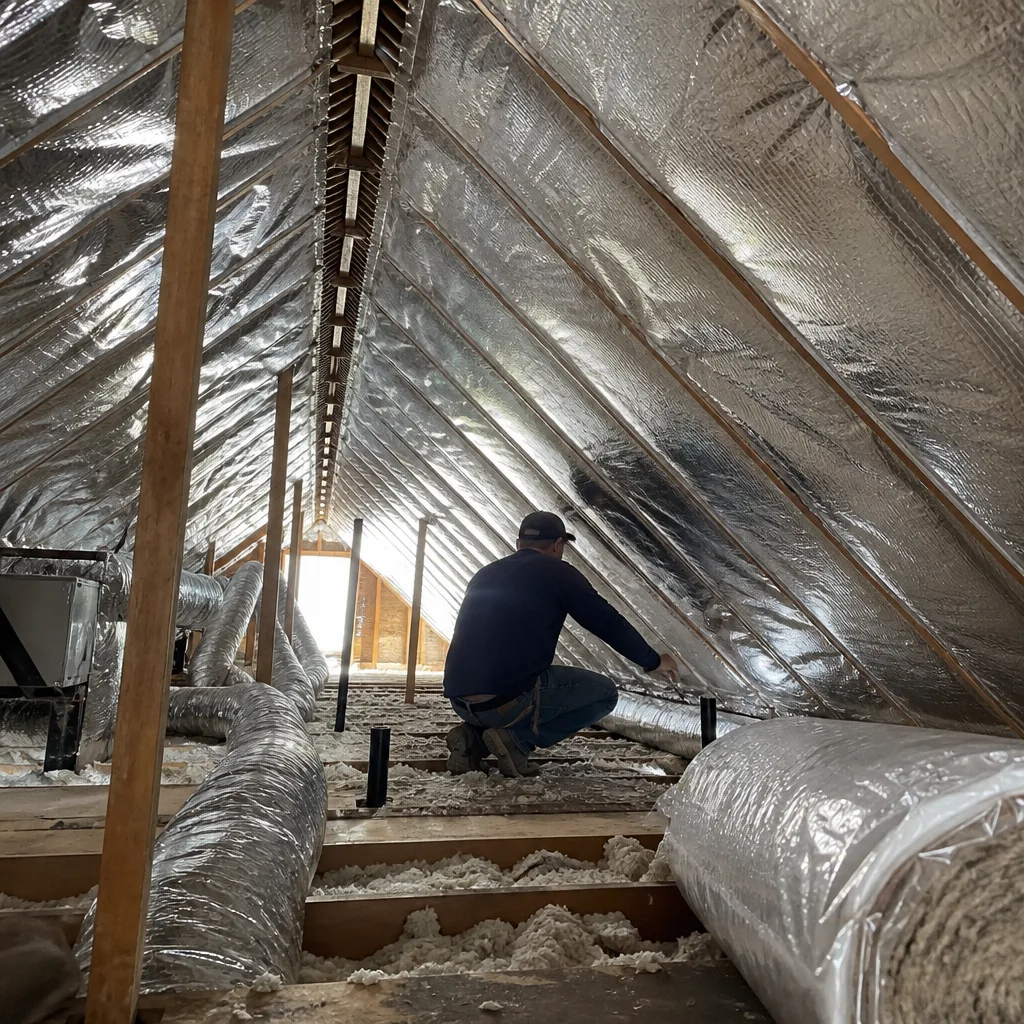
Radiant barriers reflect radiant heat rather than absorbing it. In a Cypress attic, a radiant barrier attached to the underside of the roof deck can reduce attic temperatures significantly in summer. The catch: it works best in conjunction with, not instead of, traditional insulation. If you’ve already got good attic insulation and air sealing, a radiant barrier is a reasonable add-on. It’s not the first thing to do.
Cost reality check for Cypress:
- Attic air sealing + blown-in insulation to R-38: most jobs in Cypress run between $2,400 and $4,800 depending on square footage and access.
- Crawl space encapsulation with vapor barrier: typically $3,500 to $7,500 for a standard Cypress single-story.
- Wall insulation (retrofit, dense-pack): $2 to $4 per square foot of wall area, highly dependent on siding type and access.
- Home energy audit: $200 to $500, often credited back when you proceed with work.
These are Cypress-market ranges based on jobs we’ve priced. Your exact number depends on the house. Estimates are free and upfront, and there’s no surprise line item at the end.
SCE and SoCalGas Rebates for Cypress ZIP Codes in 2025-2026
Cypress is served by Southern California Edison for electricity and SoCalGas for natural gas. Both utilities run energy-efficiency rebate programs that apply to insulation and air sealing work. The programs change year to year, but as of 2025, here’s what Cypress homeowners should know.
SCE’s Home Energy Upgrade program offers rebates for attic insulation upgrades, duct sealing, and building envelope improvements. The exact rebate amount depends on the size of the project and whether it’s part of a whole-home upgrade or a single measure. Single-measure attic insulation rebates in SCE territory typically run $0.15 to $0.30 per square foot, capped at a few hundred dollars. Whole-home upgrade paths pay more, sometimes $1,500 or more, but require a pre-approved contractor and a pre-project energy assessment. Warmline is not an SCE program administrator, but we handle the paperwork for qualifying projects and make sure the rebate actually reaches you.
SoCalGas’s Energy Savings Assistance Program is income-qualified and can cover insulation and weatherization at no cost for eligible Cypress homeowners. The non-income-qualified rebate paths are more limited for insulation alone, but air sealing and duct sealing often qualify under the gas utility’s home efficiency categories.
Federal 25C tax credit: as of 2025, homeowners can claim 30 percent of the cost of qualifying insulation and air sealing upgrades, up to $1,200 per year, through the Inflation Reduction Act’s 25C credit. Attic insulation, wall insulation, and air sealing all qualify. This is a federal credit that applies in Cypress regardless of utility. Keep your receipts and ask your contractor for the manufacturer’s certification statement.
The caveat: rebate availability and amount depend on your specific Cypress ZIP code (90630 and 90623), your income level, and whether you’re combining measures. Don’t make a $4,000 decision based on a $300 rebate. Make the decision based on the energy savings and comfort improvement, and treat the rebate as a discount, not a driver.
Material Choices That Make Sense in Cypress’s Climate
We work with materials from Owens Corning, Johns Manville, and CertainTeed, among others. The brand matters less than matching the material to the application and the climate. Here’s how we think about it in Cypress.
Blown-in fiberglass is our default recommendation for most Cypress attics. It’s cost-effective, it settles predictably, and it fills odd cavities around trusses and wiring. In Cypress’s humidity, fiberglass handles moisture better than cellulose in attics with good ventilation. For homes with poor attic ventilation, we address ventilation first, then insulate. Blown-in insulation in Cypress is the most common project we do, and for good reason: it’s fast, thorough, and effective.
Spray foam is the right material for specific situations. Closed-cell spray foam acts as both air barrier and insulation, which makes it uniquely suited to crawl space encapsulation, rim joists, and walls in homes with moisture concerns. It’s more expensive than blown-in fiberglass, but in the right application, the performance justifies the cost. Spray foam insulation in Cypress handles the coastal moisture challenge better than any other single material, which is why we use it in crawl spaces and band joists where damp air infiltration is the core problem.
Rockwool stone wool insulation is worth considering for homes where sound transmission and fire resistance matter. It’s denser than fiberglass, repels water, and doesn’t sustain mold growth. For Cypress homes near busy streets like Valley View or Katella, the acoustic isolation is a quiet, tangible benefit. It costs more, but for some homeowners, the lessened road noise is worth the premium. Our team has installed Rockwool in dozens of Cypress homes, and the feedback is consistent: quieter rooms and noticeably more stable temperatures.
Radiant barrier is a separate product from insulation. It’s a reflective foil that bounces radiant heat away from the attic floor. It works best in hot, sunny climates, and Cypress qualifies. The key is installation: it should be installed on the underside of the roof deck with proper air gap, and it’s most effective when combined with adequate conventional insulation below.
What a Proper Insulation Upgrade Actually Looks Like
If you’ve never had insulation work done, here’s what to expect from a legitimate project on a Cypress home. Most of our jobs are completed in a single visit.
- Assessment and estimate. We inspect the attic, crawl space if present, and HVAC ducts. We measure the existing insulation, look for moisture and rodent damage, and identify air leakage points. You get a written, itemized estimate with the exact scope and price before any work starts.
- Prep work. We seal off work areas, lay down floor protection, and set up dust containment where needed. All techs are background-checked and uniformed.
- Air sealing. We seal the attic floor penetrations: recessed lights, ceiling fans, plumbing stacks, top plates, and the attic hatch. This step alone typically accounts for 30 to 50 percent of the total energy benefit.
- Insulation installation. Depending on the scope, we blow in fiberglass to the target R-value, install spray foam, or fit batts. Material is applied at consistent depth and density. We don’t “fluff” fiberglass to make R-value claims that don’t hold up.
- Ventilation and final check. We confirm attic intake and exhaust are balanced, verify the hatch is sealed and insulated, and take final photos of the completed work.
- Post-project review. We walk you through what was done, what we found during the project, and what to expect in terms of comfort and energy changes. If anything isn’t right within 90 days, we come back and make it right. That’s the 90-Day Done Right Promise, in writing, on every job.
Throughout the process, you have a live person to call. Our line is answered 24/7 by a human being, not a voicemail service. If you have a question mid-project, you get an answer, not a callback promise.
Common Mistakes to Avoid
- Adding insulation without air sealing first. This is the single most common mistake we see in Cypress homes. Insulation doesn’t stop air movement. If the attic floor leaks like a sieve, blowing more fiberglass on top just gives the air a warmer path out of your house. Air seal first, then insulate. Every time.
- Ignoring the crawl space. Cypress sits on damp coastal ground, and a vented crawl space introduces moisture into the floor system all year round. Encapsulating the crawl space does more for overall home health than many people realize, and it’s frequently the missing piece for homes that still feel damp after attic work.
- Removing old insulation unnecessarily. Not every old attic needs removal. If the existing material is dry, clean, and not compacted, topping it off is often sufficient and cheaper. Removal is for contamination: rodent droppings, mold, or water damage.
- Trusting a visual inspection only. You can’t see air leaks. You can’t see heat movement. A thermal camera and blower door test reveal what eyeballs miss. Anyone who tells you they know what’s wrong without measuring is guessing.
- Choosing material based on price per bag. The installed cost per R-value per year of service is what matters. Cheap batt insulation installed poorly performs worse than mid-priced blown-in fiberglass installed correctly. Material quality comes from the manufacturer, but performance comes from installation. We use products from Johns Manville and the other benchmark manufacturers because their material specs are honest, and we install them exactly to spec.
- Blocking attic ventilation. We see this constantly: blown-in insulation covering the soffit vents because no one installed baffles. A Cypress attic without balanced ventilation collects moist marine air every single night. Baffles and ventilation belong in the project scope, not as an afterthought.
- Doing one zone and calling it done. The attic is the first priority, but it’s not the whole house. The best results come from treating the envelope as a system. Attic, crawl space, walls, ducts. They all interact. Insulating one zone in isolation leaves the others leaking.
When to Call a Professional
Insulation work involves fiberglass particles, confined attic spaces, and the potential for exposed wiring. We don’t recommend DIY attic work for most homeowners, and there are specific situations where a professional is non-negotiable. If your attic contains vermiculite insulation from before 1990, it may contain asbestos and must be tested before anyone disturbs it. If you smell gas or see water pooling in the attic, those are separate emergencies that need addressing before insulation work. If you have existing rodent damage, it needs to be remediated and the entry points sealed before new insulation goes in, otherwise you’re just re-carpeting the attic for the next generation of squirrels. Warmline Insulation Co. offers free estimates in Cypress, and we’ll tell you honestly what needs doing and what can wait. Call (657) 837-1179 and a live person will answer, any hour.
Frequently Asked Questions
Attic insulation in Cypress typically costs between $2,400 and $4,800 for a standard single-family home, including air sealing. For a fuller picture, see our Insulation Cost Breakdown: The Cypress Homeowner’s Reference for 2026. The exact number depends on the attic’s square footage, the current insulation condition, and whether removal is needed. Call (657) 837-1179 for a free, itemized estimate and a live person will walk you through the specifics of your home.
The current recommendation for attics in Cypress is R-38 to R-49, which aligns with California’s Title 24 climate zone requirements. Walls should be R-13 to R-21 depending on construction type. If your home is from the 1960s or 1970s, you’re probably well below both numbers.
For most Cypress homes, topping off existing insulation is cheaper than full removal and replacement, if the existing material is dry and clean. Removal is warranted when there’s mold, rodent contamination, or water damage. A professional inspection answers this question in about thirty minutes.
Yes. Most attic insulation and air sealing projects in Cypress are completed in a single visit. Crawl space encapsulation is typically a one-day job for standard single-story homes. Wall insulation is usually one to two days depending on the number of access holes required and the siding type.
In our experience with Cypress homes, the combination of air sealing and proper attic insulation typically reduces cooling costs by 15 to 30 percent depending on the starting condition. The exact savings depend on your HVAC equipment, your thermostat habits, and how leaky your attic was to begin with. Most homeowners notice the comfort difference within days and the bill difference within one billing cycle.
Yes. For qualifying projects in Cypress ZIP codes, we complete the rebate documentation and ensure it’s submitted correctly. You don’t have to navigate SCE’s program requirements alone. We’ve been doing this since 2011 and know the current requirements for 2025 and 2026.
The Bottom Line
A complete insulation strategy for a Cypress home is not about chasing a single R-value number. It’s about understanding what the marine-influenced climate does to your house over decades, and fixing the whole envelope in the right order. Start with the attic, because that’s where the biggest losses happen. Air seal before you insulate. Address the crawl space moisture. Then evaluate walls and ducts. Use materials that match the climate, not just the budget. And work with someone who measures, not someone who guesses. The result is a house that stays cooler in August, warmer in January, and costs less to operate every month of the year.
Written by Neil Ashford, Owner at Warmline Insulation Co., serving Cypress since 2011.